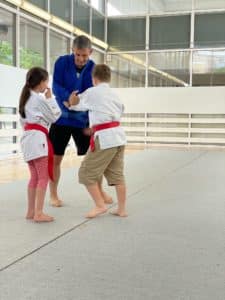
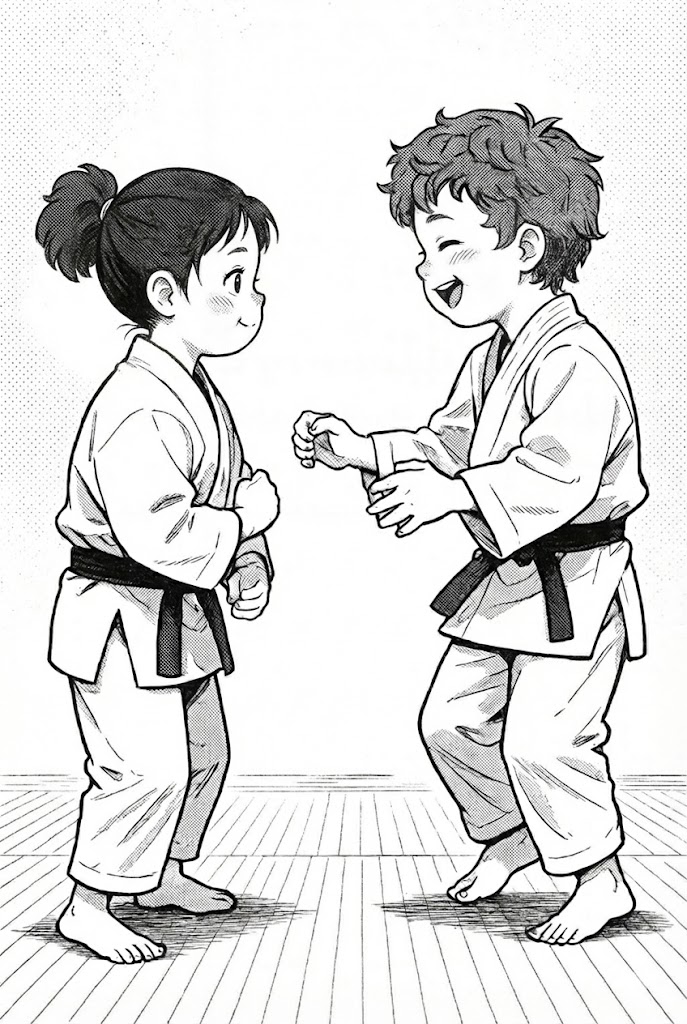
Brazilian Jiu Jitsu for little ones, taught the way small children actually learn: through play. Our Minis class is for children aged 4 and up, and it is built around games rather than drills. Less standing in a line being told what to do, more games that quietly teach balance, movement, control and confidence. Intuitive playful learning so the skill shows up because the child worked it out, not because they were ordered to copy a move.
The first class is free, so you and your child can see whether they are ready and whether it feels right. No experience needed, no special kit, no pressure
Minis class is currently taking bookings for September term’s Monday 4:45 sessions
A Minis class is loud, busy and fun, and that is by design. Your child might be “squashing the pumpkin,” keeping their feet off “the floor is lava,” or turning into a statue the instant their partner taps. Each of those games is teaching something real: how to use their weight, how to stay attached to a partner, how to stop the moment someone says stop. They will not always notice they are learning, which is rather the point.
We blend two things most children’s classes keep apart: modern movement science and the calm, patient side of martial arts. We coach with pictures a four-year-old can act on (“glue your ear to my chest”) rather than adult instructions they cannot process yet. And we set the energy of the room rather than shouting over it, so a young child’s natural wildness gets channelled into focus instead of fought. It is a thought-through method, not childminding with a mat.
The first thing we teach is not a move, it is how to be safe with another person. Children learn to respect the tap and freeze the instant a partner taps; to control their own strength around smaller friends; and to fall and roll without bracing. Groups are kept deliberately small, our coaches are enhanced-DBS checked, and no child trains unsupervised. A confident child is one who feels safe first.
Minis is the start of a path, not a one-off. As children grow they move up into our Juniors class (ages 8+), and our older teenagers can join the Young Leaders Programme, where they learn to coach the little ones themselves. We train those young coaches to be gardeners rather than drill sergeants: to offer just enough of a challenge that a smaller child has to work for the win, and then earns it. That culture is around your child from their very first Minis class.
Minis currently runs on Mondays at 4:45pm at our dojo in Finsbury, Islington. The first class is free so we can work out together whether your child is ready. After that it is £95 for a term of 12 lessons. All you need is comfy clothes; we will sort the rest.
Our children’s programme is led and managed by experienced grapplers from our BJJ and Judo teams, and every children’s coach holds an enhanced DBS check.


Is four too young to start? For some children yes, for others no, and the free first class is how we find out together. At this age it is about play, balance, listening and confidence, not competition or hard sparring. If your child is not quite ready, that is completely normal.
My child is shy, or very energetic. Will they cope? Usually yes, and the method is built to hold both the cautious child and the high-energy one in the same room. The one thing a class genuinely needs is a child who can begin to listen and let their friends take part too. If they are not there yet, that is not a failure, it just means this might not be the right moment. We would rather say so kindly than set them up to struggle.
Will they learn to fight? Not in the way some people mean it. We teach control, problem-solving and respect for a training partner, not aggression. If you are specifically after combat-first or competition-heavy training for a young child, there are gyms that specialise in exactly that and will serve you better than we will. Our focus is skills, safety and character first.
Do they need a uniform? Nothing to buy on day one. Comfy clothes are perfect for the free trial, and when your child joins we will lend them a jacket, so cost is never the reason a child cannot start. We do train in a gi rather than gym kit, partly because pulling on the uniform is a small ritual that tells a child this is a real thing they do, and partly because it is safer: grips go on the cloth, not on skin. Some parents like to buy their child their own gi once they have committed to a term, which is a nice moment, though the real markers of progress are the stripes and belts they earn, not the kit they wear.
How do they move up to the older class? When they are ready, not at a fixed birthday. We use a simple safety-first check (can they tap and freeze, stop on command, fall safely, and control their power) before they join the 8+ Juniors.